















Starting in the fall of 2021, the WEC, or Writing Exploration Center, has helped Wayzata High School students sharpen their writing skills through mentoring and peer revision.
The idea for the WEC was born in co-founder Dawn Johnson’s Compass Graphic Communications class. The project started as an opportunity to market the Academic Mentor program and then morphed into the idea of a writing center.
“We are one of the largest high schools in Minnesota,” WEC co-founder Dawn Johnson says. “And we did not have a writing center to support students.”
Mrs. Johnson, along with a group of her students, were tasked with forming the WEC for Wayzata. They had the hopes of providing equitable resources for students to get writing support without tutors that cost money.
The group completed primary and secondary research on the effects of a writing center on students, including visiting the writing centers at Minnetonka and the University of Minnesota to learn about how they ran it. Then, the group drafted an entrepreneurial presentation for the Wayzata High School administrative team.
“At the end of their presentation, Mr. Gengler said ‘Let’s open it tomorrow,’” reminisces Mrs. Johnson.
For the next semester, the WEC ran before school, after school, and during what was then called “My Time.” The program has grown tremendously in the years after its creation.
“Last year,” Mrs. Johnson says, “we served over three thousand students in the WEC.”
It was created within the schoolwide Academic Mentoring program, which employs juniors and seniors to assist teachers in class and help students one-on-one with assignments and projects. The WEC uses similar methods of helping students through peer review.
“We have a new batch of academic mentors every term,” Mrs. Haugh, the head of the Academic Mentoring department, says. “This [WEC] is one of the options that students can choose from if they have an affinity for writing and supporting the writing of others.”
Students send their essays and rubrics through the Wayzata High School Hub, where the mentors grade them based on the rubric. Work can be reviewed in time slots that one can sign up through the hub, and their material will be given feedback within that time. In addition, teachers can request WEC mentors to visit their class through WEC on Wheels.
“We try to have two to four [mentors] per block, so that we have people available,” Mrs. Haugh states. “We really try to balance the number with demand.”
Through this system, the editors provide planning, crafting, and writing strategies that provide writing knowledge for the student getting help.
“When you see a room full of students helping other students, and they’re engaging in academic work to become better writers, it’s just an amazing thing to watch,” Mrs. Johnson says.
Like all service based programs, there are hurdles, such as balancing peak times and low times. “It’s an ebb and flow,” Mrs. Johnson says. “You’re going to peak at the time where teachers are having students write essays, and you’re going to have really low points at the beginning and end of a term when those large assignments haven’t come yet or have already gone.”
Another challenge for the WEC is the switch from My time to WIN (What I Need) time at the high school. “My Time,” or “Our Time,” was a period of about 30 to 45 minutes at a set time during the school day where students could work on homework or get help from teachers.
“We were super busy during Our Time [My Time],” says Mrs. Haugh.
The switch to WIN Time changed things. WIN Time, in contrast to My Time, isn’t a set time during the day; it occurs at different times and days during the week depending on what class it is administered in. This change disorganized the submission time slots, as well as removing one of the biggest periods of WEC use during the school day.
“We’ve been able to rebuild that a little bit this year by being a little bit more flexible about teachers sending their students for support in the media center where academic mentors are housed,” Mrs. Johnson explains. “But we’re not quite where we were during Our Time.”

Despite the hit the center took from the switch from My Time to WIN time, it continues to develop, now with the MEC (Math Exploration Center) growing from it, as well as the concept of a tutoring center.
The MEC officially started last year, and it has been growing alongside the WEC. Just like its sister program, it utilizes student mentors for supporting other students who are struggling.
“As we saw the WEC develop, it was apparent there was an opportunity to do more flexible support for classes in other content areas as well,” reflects Mrs. Haugh. “In the last few days, I’ve had five mentors with me, and we’ve been going into an intermediate algebra class and running stations to give the students more personalized feedback.”
Also beginning last year, the MEC has started a tutoring center concept.
“We identified students who would benefit from additional one-on-one support from a mentor and then worked with them on a weekly basis on whiteboards,” explains Mrs. Haugh.
With these additions in mind, Mrs. Johnson and Mrs. Haugh look for mentors with more than just writing skills.
“Ideally when we look for WEC mentors, we want someone who’s well-rounded enough to be able to help in multiple subjects,” Mrs. Haugh says. “A lot of the WEC mentors are also MEC mentors, meaning that they can support in a variety of content areas.”
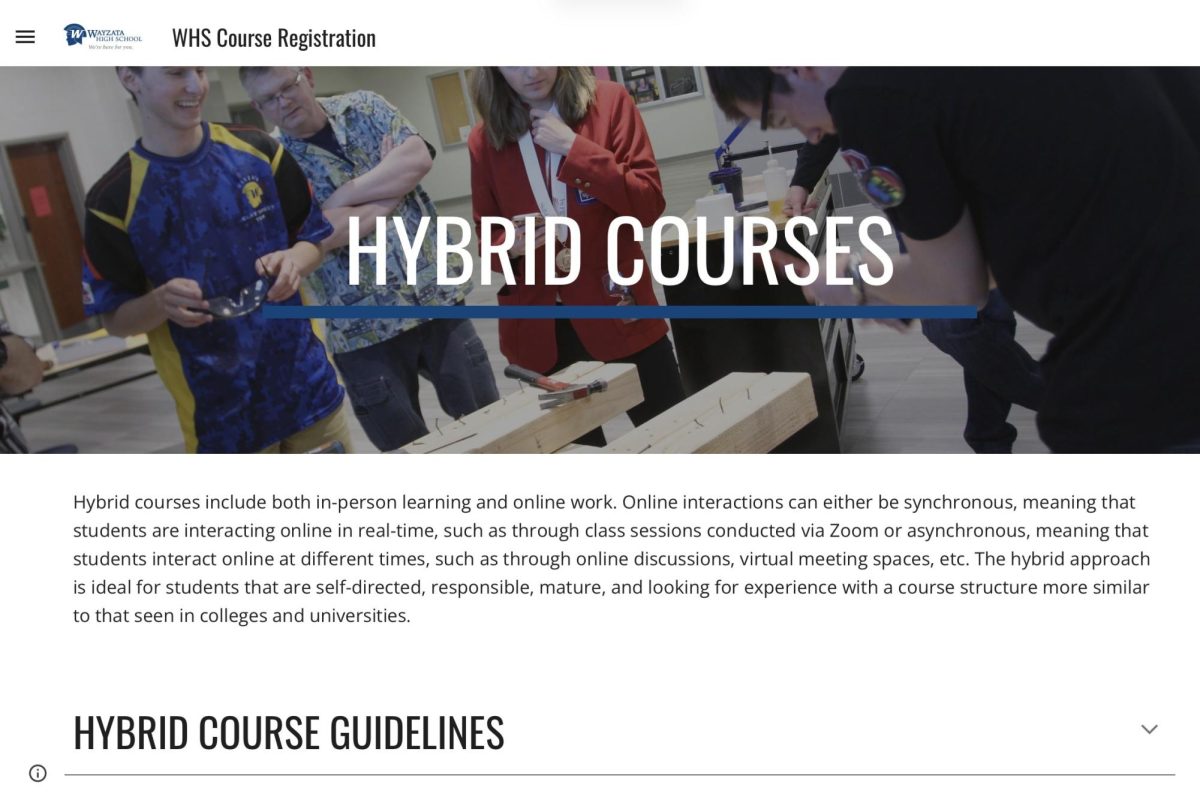
Along with proficiency in multiple subjects, to be a mentor for the WEC or MEC, students must first take a prerequisite course in Academic Mentoring. The class is called “Academic Mentor – Foundations of Leadership,” and through this one-term course, aspiring mentors learn about leadership and methods of revision needed to be a successful WEC/MEC mentor. This course is open to juniors and seniors, but with teacher recommendation, sophomores can take this class as well.
Though the program requires credits to enter, it is reportedly rewarding.
“I like helping people and giving them feedback, because I know it’s hard to see what you need to improve on with your own writing,” says senior mentor Marin Reitz. “It’s good for your own writing ability to help other people so that you can ask, ‘what could I be doing better?’”
The WEC has greatly developed within the last four years, and through its challenges it continues to attract mentors and adapt to the needs of students at Wayzata.
Sources:
https://www.wayzataedfund.org/wec2022
WEC Mentor Marin Reitz
https://sites.google.com/wayzataschools.org/whs-course-catalog/general-electives