











With a week full of all-nighters and stacks of empty Monster cans right by your study table, finals week can feel like a century-long phase with anxiety attacks hovering around you, ready to pounce on your sanity. Teenagers can suffer from high stress and panic attacks while grinding notoriously right before a mind-boggling test that determines half their grade. Fortunately for you, we’ve got you–just like how Jackie Chan got Chris Tucker–with some mega useful final advice any teen would die for.
Through a Wayzata High School poll on the best ways to study, students reported a variety of study habits that they were using to prepare for finals. Making notecards is a popular mode of studying, whether through Quizlet or handmade. Notecards or flash cards are a helpful tool for active recall, another highly recommended study strategy. Through active recall, you stimulate your brain with the active retrieval of information, helping to better retain those topics for exams. This strategy is much better than mindlessly highlighting key information and rereading textbook chapters, as it requires you to be engaged and pull out information from your memory. Not only this, but active recall also fights what is called the forgetting curve.
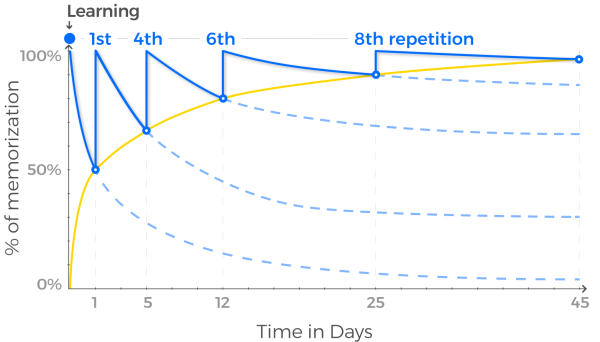
In simple terms, when you repeatedly review a topic, the rate at which you forget the information slows (as seen in the photo above). Due to this process, repeatedly recalling information through flashcards or teaching others will allow you to remember the topics for your upcoming exam clearly and easily.
In studying for exams, it is also important to make sure that you use your resources. Teachers often provide review sheets on Canvas, or you can find YouTube explanation videos on the web. For all things math and science, Khan Academy is the way to go. For history classes, especially AP Euro and AP US History, Heimler’s History and Crashcourse History are your new best friends. In history classes, it is also recommended to create a timeline of all the readings or main events in each chapter, then move into the nitty-gritty specifics to keep in mind. Another way to be confident in the tested topics is to pay close attention during lectures in class. Take notes, ask your teacher questions, discuss with friends, and do all your homework well.
It is also important not to let your knowledge be half-baked, so give it enough time in the oven for it to actually stick. Before you open your laptop, you have to decide what kind of academic athlete you are: a track runner who covers everything in an hour, or a tennis player who studies triple that? No matter how long you study, you are an athlete, and breaks are more than necessary. Finals are like a championship season, so it is vital to manage your intervals so that you don’t burn out before exam day. Your brain is a muscle, so the high-intensity interval training called the “Pomodoro Technique” is widely effective. Set a timer for 25 minutes to indulge in deep work with no music with lyrics, just pure focus. Then set a timer for a breath of 5 minutes to stand up, stretch, or grab water. Note that doomscrolling will distract you and hurt you in the long run, so keep your phone away from you during this time.
After you have completed this cyclic roundabout (generally 4 times), reward yourself with a treat! Remember, you can’t run on a bag of Cheetos; your brain consumes about 20% of your body’s energy just studying for 2 hours. It is important to add some water and crunchy grapes to fuel your memory machine. If 25 minutes feels too short, try 50 minutes of work followed by a 10-minute phone-free walk, then feel your brain refocus each time you sit back down at your study table. Some people can sprint through a textbook in three hours, and others need six. An athlete who knows their own pace always finishes the race; the one who tries to copy someone else’s speed is the one who crashes and burns.
For the heavy weight STEM subjects like AP Calc, Physics, Chem, and Bio, students recommend spending 70% of your time doing practice problems and 30% on content review. You can’t rush building up muscle, and you can’t rush solving a derivative problem. Give yourself plenty of time so that problem-solving can turn into multiple full-length practice exams, similar to the test. Keep in mind, with STEM subjects, 1 hour of focus on problem sets is much more efficient than 4 hours of memorizing formulas and plain sight reading.
Moving on: for the historians, it is all about mental cardio—enduring and keeping a steady pace through massive amounts of data. Your training volume should consist of 20% reading, 70% active recall, and any remaining time for review. These are “Highway miles”: once you get into a groove, you can cover a lot of ground, but if you zone out for an hour, you’ve missed a whole century.
Lastly, The Analysts. If you are an English AP kid in Lit or Lang, it is not about how much you write; it is about how you write. Take a timed practice essay, then spend 1 hour rewriting the same essay according to a 5-point rubric. These are track laps, repeating the same motions (essay structures or data interpretations) until they become second nature. Remember: you cannot cram for AP Lang by reading; you have to write! Schedule your hours by doing 40-minute writing drills, and at one point, your brain will be able to analyze text on autopilot when pressure is at its peak.
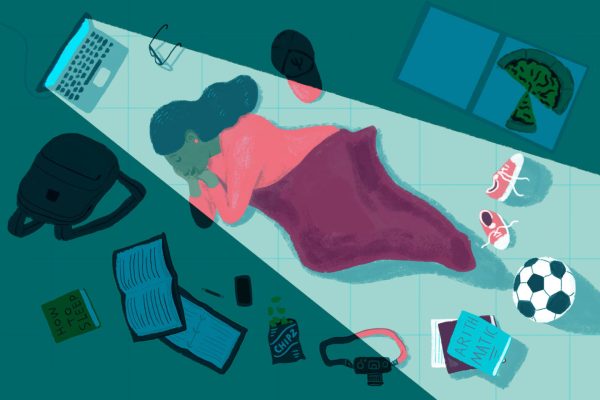
Study strategies and how long to study are two important things to think about with finals coming, but it is also vital to get enough sleep. Yes, you have heard it a million times, but that just further proves its importance. Harvard Medical School says that not getting enough sleep negatively affects the brain’s ability to process new information and retain it for any period of time. High-school-aged teens (13-18) are strongly recommended to get between 8 and 10 hours of sleep every night. If you don’t have time to get that much, that’s okay; it can feel overwhelming trying to fit in so much sleep time in a busy schedule. Still, try to get as much as you can–it’ll help you in the long run. While you sleep, your brain works on memory consolidation and organization of information, among other tasks. This means that no matter how much you study, if you don’t sleep enough throughout exam week, you won’t be at your best. Remember, not getting enough sleep is not a flex. Sleep is necessary for everything in life, especially for getting good grades.
Overall, it is important to plan out your studying before finals. Find the strategy that works best for you, and make sure it involves engaged thinking. The amount of time you study is important, yet it is relative to your workload and strength in each class. With these two, and adequate sleep, you will be acing finals in no time.